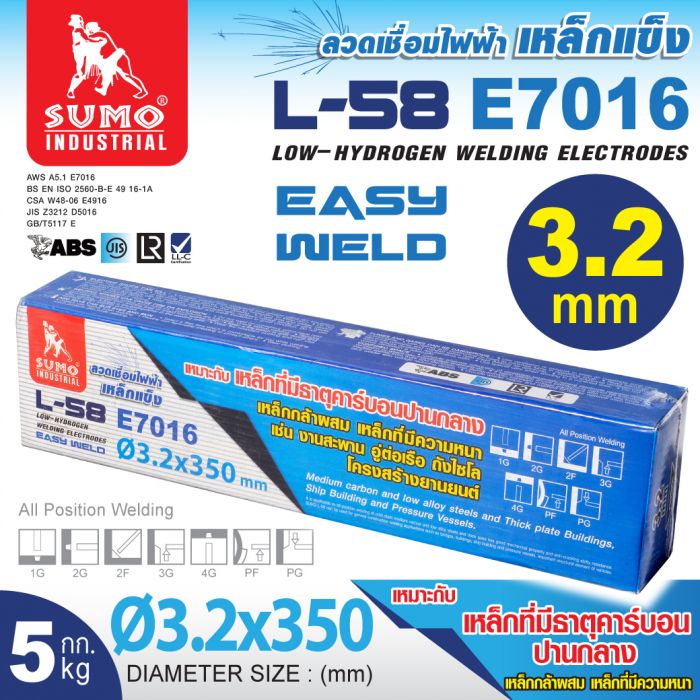
ลวดเชื่อมไฟฟ้าเหล็กแข็ง L-58(E7016) 3.2x350mm
Cast Iron Rod 3.2x350mm
LOW HYDROGEN ELECTRODE SUMO E7016 3.2x350mm
Features & Applications
E7016 is used for main parts of ships, e.g. boilers, pressure vessels and pipes made by equivalent tensile strength steel, such as A B D E Ah36 or Eh36. Also it can be applied to homothetic strength structures of bridges, machineries, vehicles constructions, and so on. The weld metal has good performance of plasticity, impact toughness and crack resistance.
Chemical Composition of Deposited Metal (%)
|
Test item |
C |
Mn |
Si |
S |
P |
Ni |
Cr |
Mo |
V |
|
Standard |
≤0.15 |
≤1.60 |
≤0.75 |
≤0.035 |
≤0.035 |
≤0.30 |
≤0.20 |
≤0.30 |
≤0.08 |
|
Actural reset |
0.075 |
1.12 |
0.48 |
0.015 |
0.019 |
0.2 |
0.02 |
0.02 |
0.3 |
The total amount of element with *ones should be≦1.75%
Mechanical Properties if Deposited Metal (AW)
|
Test item |
Tensile Test Of Deposited Metal |
V-Notch Impact Test |
|||||
|
Tensile strength Rm(MPa) |
Yield point ReL(MPa) |
Elongation (%) |
Impact Temp (℃) |
Impact value Average (J) |
X-Ray |
Diffusion hydrogen content (ml/100g) |
|
|
Standard |
≥490 |
≥400 |
≥20 |
-30 |
≥27 |
I |
≤7 |
|
Actural Result |
575 |
456 |
30 |
-30 |
123,110,124 |
I |
2.3 |
Size & Recommended Current (AC≧70V or DC+)
|
Size(mm) |
2.5x300 |
3.2x350 |
4.0x400 |
5.0x400 |
|
|
Current(A) |
F, H |
70-110 |
100-140 |
140-180 |
180-230 |
|
V, OH |
50-80 |
80-110 |
130-170 |
- |
|
Guidelines for use
- All water, rust and oil should be complexly removed from base material to prevent cracking and blowholes.
- For improved impact properties, avoid used of excessive amperage levels.
- Backstep method should be applied to prevent blowholes and pits during arc start.
- Arc length should be kept as short as possible during welding
- If weaving is required, the width should not exceed 3x the diameter of the electrode.
Redrying
- All controlled hydrogen electrodes will perform optimally when they are dry.
- Excellent protection against moisture pick-up in good storage conditions.
- Should redrying be necessary, remove electrodes from the packet/ container and spread thinly and evenly on racks in a ventilated oven
- For electrodes that have had a short or mild exposure to the atmosphere then re-drying at 572 F°(300 °C) for 1 hour will be sufficient
- For electrodes that have been exposed to longer or more aggressive conditions or for critical work re-drying at 572-662 °F(300-350 °C) for 1-2 hours is recommended. After re-drying electrodes should be stored in a hot box